

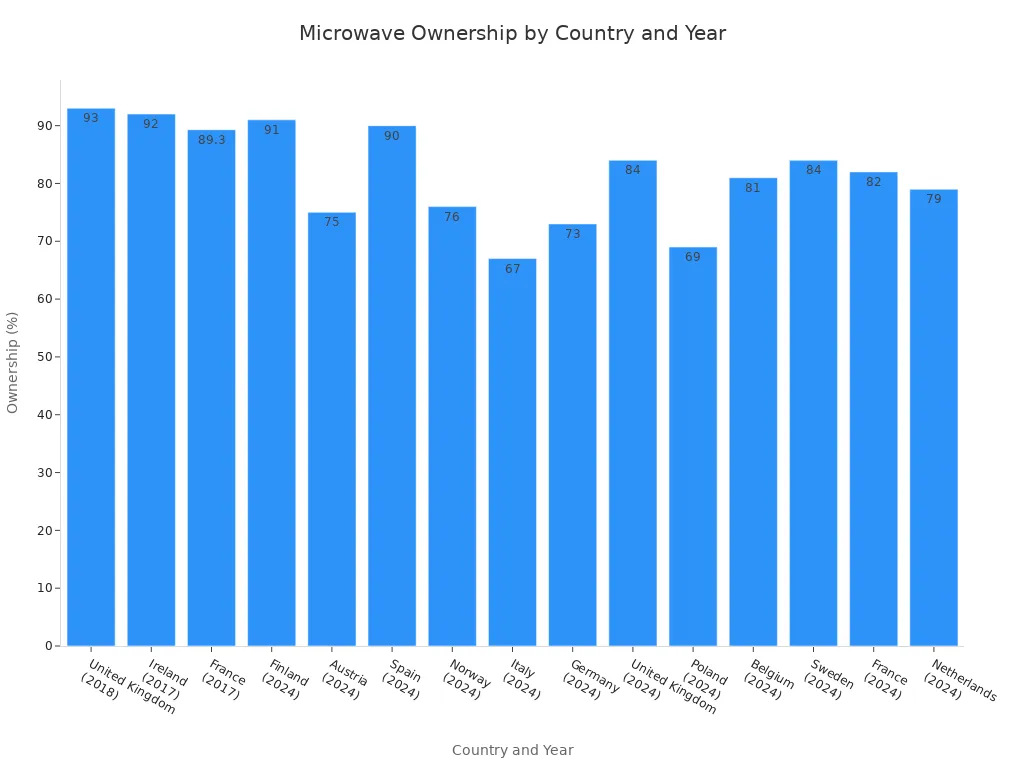
A microwave grill pan cannot fully replicate the crispy, evenly cooked results of an air fryer, especially for dishes like chicken wings and fries. Nevertheless, it provides a unique solution for particular culinary needs. Many homes already feature a microwave, making a microwave safe grill pan a convenient addition. This includes specialized items such as a microwave pizza crisper pan or a microwave sandwich grill pan. A versatile grilling frying pan, often a round microwave frying grill pan, expands cooking options. The prevalence of microwaves globally supports this utility:
Key Takeaways
- A microwave grill pan adds grill marks and some browning to food. It does not make food as crispy as an air fryer.
- An air fryer cooks food by blowing hot air around it. This makes food very crispy, like fried food, but uses less oil.
- Air fryers are better for making crispy foods like chicken wings and french fries. They cook food evenly and make it crunchy.
- Microwave grill pans are good for quick tasks like grilling vegetables or making sandwiches. They heat up fast and are easy to use.
- Both tools offer healthier ways to cook than deep frying. Your choice depends on if you want grilled texture or crispy food.
Understanding the Technology: Microwave Grill Pan vs. Air Fryer
How a Microwave Grill Pan Works
A microwave grill pan offers a unique approach to cooking within a standard microwave oven. This specialized pan typically features a non-stick surface and a base material designed to absorb microwave energy. When microwaves hit the pan, the base material heats up to very high temperatures. This intense heat then transfers directly to the food, searing its surface and creating grill marks. The pan effectively converts microwave energy into conductive heat, allowing users to achieve a grilled texture and browning that a conventional microwave cannot produce alone. A microwave grill pan provides a convenient way to add a grilled finish to various dishes.
How an Air Fryer Works for Crispy Results
An air fryer operates as a compact convection oven. It cooks food by rapidly circulating hot air around it with a powerful fan. This method allows food to achieve crispiness similar to deep-fried items but uses significantly less oil. The intense hot air effectively performs roasting and grilling-like preparations. Air fryers achieve the Maillard reaction through this hot air circulation rather than hot oil. The Maillard reaction is a chemical process. It involves heating sugars and proteins, which results in food browning and becoming crispy. This process gives steaks their sear, makes chips crisp, and helps pastries achieve a golden-brown color.
Several key components facilitate this cooking process. A heating element, located at the top, heats up when the appliance turns on. A fan, positioned above the heating element, circulates hot air rapidly around the cooking chamber. This chamber is where food rests, designed for even hot air distribution to cook food from all angles and create a crispy layer. A removable drip tray or basket holds the food. It also collects excess oil or moisture, preventing sogginess. Controls allow users to adjust temperature and time, customizing the cooking process for different foods.
The Ultimate Test: Chicken Wings Showdown
Preparing Chicken Wings for Testing
For a fair comparison, the preparation of chicken wings remained consistent across all tests. Testers selected fresh chicken wings, ensuring they were thoroughly cleaned and patted dry with paper towels. This crucial step removes excess moisture, which significantly aids in achieving a crispier skin during cooking. Next, they seasoned the wings simply with salt and pepper. This minimal seasoning allowed the natural flavor of the chicken and the effectiveness of each cooking method to stand out clearly. Uniform preparation ensures that any observed differences in the final product stem directly from the cooking appliance, not from variations in initial handling.
Chicken Wings in the Microwave Grill Pan
Cooking chicken wings in the microwave grill pan presented a unique set of results. Testers placed the seasoned wings directly onto the preheated microwave grill pan. The pan effectively seared the surface of the wings, creating some browning and distinct grill marks. However, achieving uniform crispiness across the entire wing proved challenging. The microwave energy primarily heats the pan, which then cooks the food through direct conduction. This method resulted in parts of the wing becoming somewhat crispy where they directly contacted the hot surface. Other areas, not in direct contact with the pan, remained softer and lacked the desired crunch. The cooking time was relatively quick, but the overall texture lacked the consistent crispiness associated with traditionally fried or air-fried wings. The microwave grill pan offered a grilled appearance but did not deliver a consistently crispy skin.
Air Fried Chicken Wings Performance
The air fryer demonstrated its superior capability for producing crispy chicken wings. Testers preheated the air fryer to 380°F. They then arranged the seasoned chicken wings in a single layer within the air fryer basket, carefully avoiding overcrowding. The wings cooked for 10 minutes at this initial temperature. After this period, testers increased the temperature to 400°F. They continued cooking the wings for an additional 6-8 minutes until they became crisp and golden. This two-stage cooking process ensured the wings cooked thoroughly and developed a beautifully golden, crispy exterior. The rapid circulation of hot air evenly cooked the wings from all sides. This method resulted in a consistently crispy skin and tender, juicy meat inside. The air-fried wings achieved a texture closely resembling deep-fried wings, but with significantly less oil.
The Ultimate Test: Fries Showdown
Preparing Fries for Testing
Testers ensured consistent preparation for the fries. They cut potatoes into 1cm pieces. This uniform size promotes even cooking. Some batches involved soaking potatoes in brine for enhanced flavor. Other testers left the skin on russet potatoes, adding texture and nutrients. Soaking cut potatoes in cold water for a few hours also occurred. This step removes excess starch, which helps achieve a crispier final product. After soaking, testers thoroughly patted the potato pieces dry. Removing moisture is crucial for crispiness in both cooking methods.
Fries in the Microwave Grill Pan
Cooking fries in the microwave grill pan yielded mixed results. Testers placed the prepared potato pieces directly onto the heated pan. The pan attempted to sear the fries, creating some browning where the potatoes touched the hot surface. However, the fries did not achieve a uniform crispiness. Parts of the fries became somewhat firm, but other sections remained soft and lacked the desired crunch. The microwave grill pan struggled to replicate the texture of traditional fried fries. The method produced cooked potatoes, but they did not possess the characteristic crisp exterior of well-made fries.
Air Fried Fries Performance
The air fryer delivered superior results for the fries. Testers placed the potatoes in a single layer in the air fryer basket. They ensured the pieces did not touch. This prevents steaming and promotes even cooking. The air fryer cooked the fries for 12 to 15 minutes at 380°F. Testers flipped the fries halfway through the cooking time. They continued air frying until the fries became crispy and browned around the edges. The average cooking time for french fries in an air fryer is approximately 12 to 15 minutes. Various online recipes support this range. For example, homemade fries often take around 14 minutes. ¼-inch thick fries require 14 to 16 minutes. ⅜-inch thick fries typically need 15 minutes. Sweet potato fries cook in about 12 minutes. The rapid hot air circulation produced consistently crispy and evenly cooked fries. They achieved a golden-brown color and a satisfying crunch.
Direct Comparison: Crispiness and Texture
Achieving Crispy Chicken Wings
Achieving true crispiness in chicken wings involves specific mechanical and acoustical properties. Experts often use mechanical techniques like flex, shear, and compression tests to simulate the chewing experience. They also employ acoustical techniques, measuring frequency, intensity, and the number of sound events to quantify crispness. The air fryer consistently produced chicken wings with superior crispiness. Its rapid hot air circulation created a uniformly crunchy skin, satisfying both mechanical and acoustical criteria for crispness. The air fryer’s method effectively rendered fat and dehydrated the skin, leading to a desirable texture. In contrast, the microwave grill pan offered some browning and grill marks where the wings contacted the hot surface. However, it struggled to achieve consistent crispiness across the entire wing. Areas not directly touching the pan remained softer, lacking the characteristic crunch associated with well-cooked wings.
Achieving Crispy Fries
For fries, compositional factors like water and oil content significantly contribute to crispness. Structural properties such as moisture content, thickness, pore size, porosity, and density also play crucial roles. The air fryer excelled at producing crispy fries. Its hot air circulation efficiently reduced moisture content, creating a golden-brown exterior with a satisfying crunch. The air fryer’s ability to cook evenly from all sides ensured that each fry achieved a consistent texture. This method effectively created the desired structural properties for crispness. The microwave grill pan, however, delivered less impressive results for fries. While it could heat the potatoes and create some browning, it failed to achieve the uniform crispiness of air-fried versions. Many fries remained soft or became chewy, indicating an inability to adequately reduce moisture and develop the necessary structural integrity for a truly crispy texture.
Direct Comparison: Cooking Time and Convenience
Speed of the Microwave Grill Pan
The microwave grill pan offers notable speed for certain cooking tasks. It heats up very quickly, making it a convenient option for fast meal preparation. A microwave grill pan typically needs only 2 or 3 minutes to preheat. For example, searing steak requires a 3-minute preheat on high. Pan-fried salmon needs just 2 minutes of preheating. This rapid readiness allows users to begin cooking almost immediately, saving valuable time in the kitchen. Its integration with a standard microwave also means less counter space is occupied, contributing to overall convenience.
Efficiency of the Air Fryer
Air fryers also demonstrate efficiency, though with a slightly different operational profile. They require a preheating period before cooking begins. The typical preheating time for an air fryer generally falls within a range of 3 to 5 minutes. This duration can vary based on the specific model and manufacturer’s instructions. Excessive preheating can make the air fryer too hot, potentially burning food or causing uneven cooking. Air fryers consume a moderate amount of energy during operation. They generally have a power rating between 800 and 1500 watts. During operation, they consume between 0.9 kWh and 1.5 kWh per hour. For instance, a 30-minute cooking session would use approximately 0.45 kWh. Average models use about 1,500 watts, translating to roughly 1.4–1.7 kilowatts per hour of electricity.
Direct Comparison: Versatility and Best Use Cases
Best Uses for a Microwave Grill Pan
A microwave grill pan offers a unique set of advantages, particularly for quick and healthy meal preparation. This innovative kitchen tool excels at grilling, browning, and crisping various foods. It provides a healthier grilling option, eliminating the need for propane or charcoal and avoiding harmful chemical contamination. The pan also facilitates the draining of fat from meats, leading to lower-calorie dishes. Users can prepare lighter, healthier meals without compromising flavor or texture. The speed and efficiency of cooking are primary advantages; a microwave grill pan heats up quickly and cooks food faster than traditional grills, making it ideal for busy schedules. It offers incredible convenience, requiring no propane or charcoal, and is often dishwasher safe and compact for storage. This makes it perfect for busy households or those seeking grilled food without the hassle. Specific applications include grilling vegetables like bell peppers, zucchini, and asparagus, cooking fish and seafood while retaining moisture, and grilling fruits such as pineapple and peaches to enhance sweetness. It also handles quick grilling recipes like spicy grilled shrimp skewers or grilled Caprese sandwiches.
Best Uses for an Air Fryer
An air fryer demonstrates remarkable versatility, making it a valuable appliance for many cooking tasks. It significantly reduces fat intake by cooking with hot air instead of oil, which promotes heart health by lowering saturated fat consumption. This method also reduces the formation of cholesterol oxidation products (COPs), especially in fish, and helps preserve essential nutrients by sealing in natural juices. Air fryers can fry, roast, bake, grill, and reheat, consolidating multiple cooking functions into one compact appliance. Their compact size and faster cooking times contribute to energy efficiency. They offer convenience and save time, beneficial for busy individuals who want more home-cooked meals. Simple controls and pre-programmed features allow even beginners to achieve professional-like results. The air fryer excels at preparing fresh vegetables and roasted sides, such as crispy potatoes and caramelized Brussels sprouts. It also handles proteins like tender chicken breasts and flaky fish, and it transforms frozen foods, like fries and spring rolls, into crisp, craveable bites. Furthermore, it proves surprisingly versatile for baking items like egg cups and reheating pastries or bread.
A microwave grill pan effectively adds grilled texture to various foods. However, it does not replace an air fryer for achieving consistent crispiness and even cooking. The air fryer consistently delivers superior “fried” results, producing uniformly crunchy textures. The microwave grill pan therefore serves a different, more limited purpose, offering convenience for specific grilling tasks rather than comprehensive crisping.
FAQ
Can a microwave grill pan fully replace an air fryer?
No, a microwave grill pan cannot fully replace an air fryer. It adds grilled texture and browning. However, it does not achieve the consistent crispiness and even cooking an air fryer provides, especially for items like chicken wings and fries.
What foods are best for a microwave grill pan?
A microwave grill pan excels at grilling vegetables, fish, and fruits. It also works well for quick searing tasks like making grilled sandwiches or heating pre-cooked meats. It offers a healthier grilling option without propane or charcoal.
What are the main benefits of an air fryer?
An air fryer offers versatile cooking methods, including frying, roasting, and baking. It significantly reduces fat intake by using hot air instead of oil. It also provides consistent crispiness and even cooking for a wide range of foods.
Is a microwave grill pan healthier than an air fryer?
Both appliances offer healthier cooking options compared to deep frying. A microwave grill pan helps drain fat from meats. An air fryer reduces oil usage significantly. The “healthier” choice depends on specific cooking needs and desired results.


