
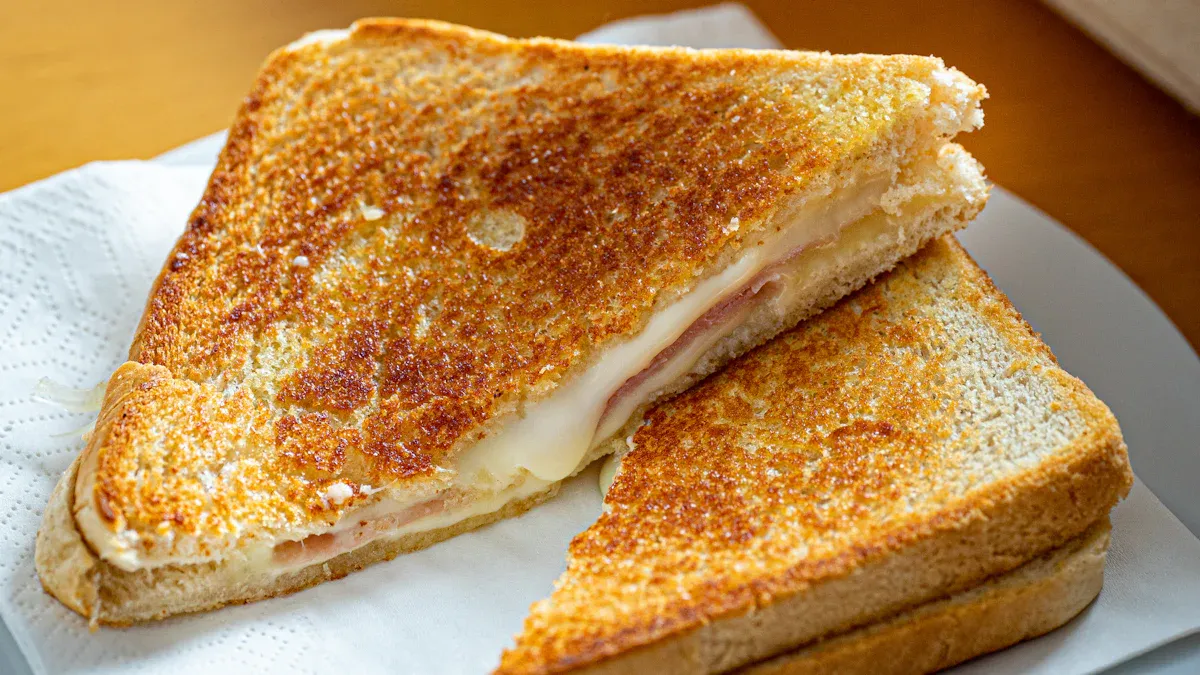
Deciding on the perfect sandwich maker for your kitchen involves weighing different priorities. You face a core dilemma: do you want quick convenience or those classic, perfectly toasted results? Many people choose a Microwave Sandwich Maker for its speed. They might use a Microwave Pan or a Grill Pan for Microwave to achieve a quick meal. Understanding how to use a Microwave Grill or How to Use Microwave Frying Pan can really expand your fast meal options. Finding the Best Microwave Sandwich Maker Supplier in China might also be a consideration for some buyers.
Key Takeaways
- Microwave sandwich makers cook food very fast, usually in 3-5 minutes, and do not need pre-heating.
- Traditional sandwich makers make bread crispy and golden brown, and they melt cheese perfectly.
- Both types of sandwich makers can cook more than just sandwiches, like eggs or pancakes.
- Both sandwich makers are easy to use and clean, often having non-stick surfaces.
- Microwave sandwich makers cost less to buy, but traditional ones might use less energy over time.
Speed and Convenience: The Microwave Sandwich Maker Advantage

Cooking Time and Preheating
A Microwave Sandwich Maker truly shines when speed is the top priority. It cooks food very fast. People can prepare a standard sandwich in just 3-5 minutes. This device does not need any pre-heating. This saves a lot of time in the kitchen. Users can achieve golden, crispy exteriors and melted interiors quickly. This quick cooking time makes it perfect for busy mornings or a fast lunch break. You simply assemble your sandwich, place it in the Microwave Sandwich Maker, and let it do its work.
Portability and Setup
These devices are also very portable. Their compact design makes them easy to store and move. For example, a Microwave Sandwich Maker & Waffle Maker 2-in-1 Set measures 7″D x 6″W x 2.2″H and weighs only 29.1 ounces. Another option, a Microwavable Toaster, has package dimensions of 7.17 x 6.02 x 1.89 inches and weighs 1.37 pounds.
| Product Name | Dimensions (D x W x H) | Weight |
|---|---|---|
| Microwave Sandwich Maker & Waffle Maker 2-in-1 Set | 7″D x 6″W x 2.2″H | 29.1 Ounces |
| Microwavable Toaster | 7.17 x 6.02 x 1.89 inches | 1.37 pounds |
Their small size means they take up little counter space. People can easily pack them for travel or use them in dorm rooms or small apartments. Setting up a Microwave Sandwich Maker is also very simple. You just place it in the microwave. There are no complex wires or multiple parts to assemble. This makes it a hassle-free option for quick meals anywhere with a microwave.
Taste and Texture: Traditional Sandwich Makers’ Edge
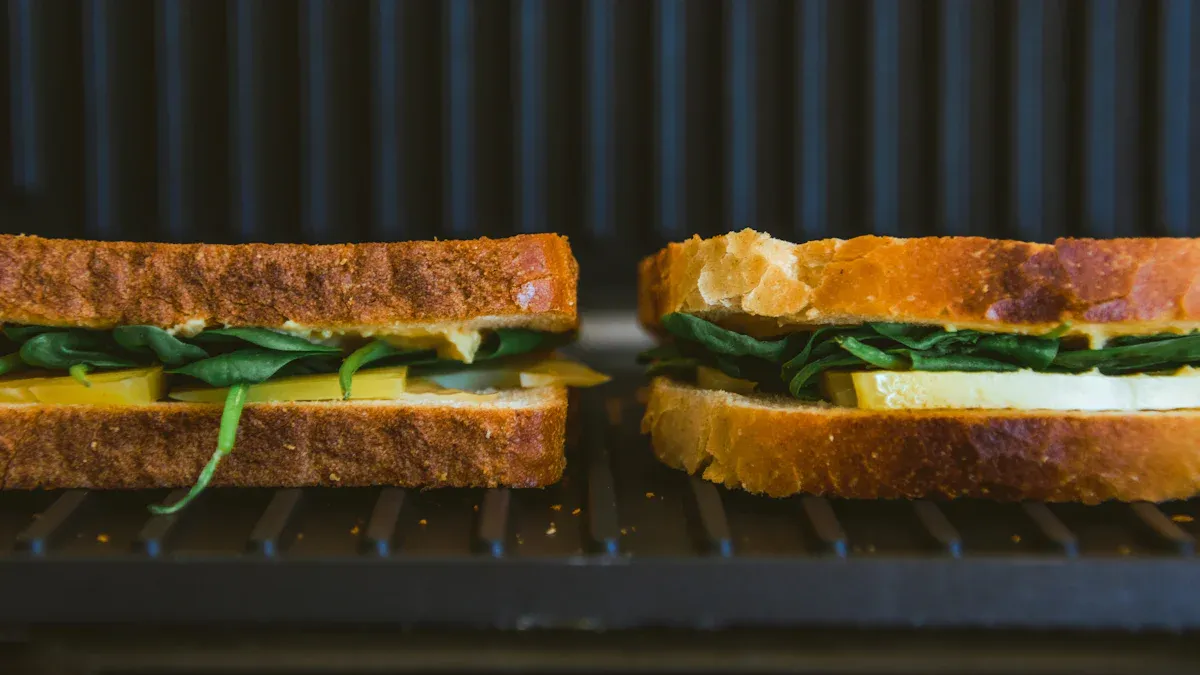
Traditional sandwich makers truly stand out when you crave that perfect taste and texture. They offer a distinct advantage over microwave options. These machines create a classic sandwich experience.
Achieving Crispiness and Browning
Traditional sandwich makers excel at making bread wonderfully crispy and golden brown. They use direct heat and pressure. This combination creates a desirable crust. For example, a grilled cheese sandwich comes out with a satisfying crunch. A skillet or griddle needs medium heat for golden-brown bread. This means about 300 degrees Fahrenheit if you use an electric skillet. The browning process, called the Maillard reaction, works best between 284 and 330 degrees Fahrenheit (140-165 degrees Celsius). Going above 350 degrees Fahrenheit (176 degrees Celsius) can burn the bread. Traditional makers maintain these ideal temperatures. They give you that perfect, evenly browned surface every time.
Cheese Melting Quality
Traditional sandwich makers also deliver superior cheese melting. The consistent, even heat melts cheese thoroughly. It creates a gooey, stretchy texture. The cheese melts from the inside out. This prevents it from becoming rubbery or unevenly heated. The direct contact with hot plates ensures every bit of cheese becomes perfectly soft. This results in a much more satisfying bite. You get that classic, melty cheese pull.
Versatility Beyond Sandwiches
Many people think sandwich makers only make sandwiches. However, both microwave and traditional models can do more. They offer surprising versatility in the kitchen.
Microwave Sandwich Maker Capabilities
A Microwave Sandwich Maker is great for quick meals. It can heat up more than just bread and fillings. People often use it to warm up leftovers like small pieces of pizza or quesadillas. It can also quickly cook single servings of eggs or even small portions of vegetables. Think of it as a fast, compact cooking tool for small items. Its main strength remains speed and convenience for simple, individual portions.
Traditional Sandwich Maker Versatility
Traditional sandwich makers truly shine when you want to get creative. They use direct heat and pressure, which opens up many cooking possibilities. You can make a variety of dishes beyond just grilled sandwiches. For instance, people use them to prepare:
- Cheese latkes
- Rewarmed frozen pizza bagels
- Melted cheese on pasta
- Heated premade noodles with shredded cheese
- Omelettes
- Pancakes
- French toast (without maple syrup)
These machines can press and cook items evenly. This makes them perfect for quick breakfasts or snacks. The hot plates create a nice crust on pancakes or French toast. They also melt cheese perfectly into pasta or noodles. This versatility makes a traditional sandwich maker a handy tool for many different meals.
Ease of Use and Cleaning
Operation Simplicity for Both Types
Both microwave and traditional sandwich makers offer straightforward operation. Users find them easy to handle. With a traditional sandwich maker, you typically plug it in, wait for it to heat up, place your sandwich inside, and close the lid. Indicator lights often tell you when it is ready and when cooking finishes. A Microwave Sandwich Maker works even more simply. You assemble your sandwich in the device, then place the entire unit into the microwave. You set the microwave timer, and it cooks your meal. Neither type requires complex settings or advanced cooking skills. They both aim to make meal preparation quick and hassle-free for anyone.
Non-Stick Surfaces and Maintenance
Cleaning is another important factor for kitchen appliances. Most modern sandwich makers, both traditional and microwave versions, feature non-stick surfaces. This design makes cleaning much easier. Food does not stick to the plates, so users can usually just wipe them down with a damp cloth or paper towel after use.
- Traditional Sandwich Makers: Many models have removable plates. You can take these plates out and wash them in the sink or even put them in a dishwasher. This makes deep cleaning very convenient. For models with fixed plates, a simple wipe-down usually suffices once the unit cools.
- Microwave Sandwich Makers: These devices are often made from microwave-safe plastic or silicone. They are typically very easy to rinse clean. Some models are also dishwasher-safe, offering maximum convenience. Their simple design means fewer nooks and crannies for food to get stuck. This saves users time and effort on maintenance.
Tip: Always let your sandwich maker cool down before you attempt to clean it. This prevents burns and makes the cleaning process safer and more effective.
Cost and Value
When choosing a sandwich maker, the price tag and how much it costs to run both play a big role. People want to know they are getting good value for their money.
Initial Purchase Price Comparison
Microwave sandwich makers usually cost less upfront. You can often find these simple devices for under $20. They are a budget-friendly option for quick meals. Traditional sandwich makers, on the other hand, typically have a higher initial price. Their cost can range from $20 for basic models to over $100 for more advanced ones with extra features. These features might include removable plates or temperature controls. So, if you are looking to spend less money right away, a microwave option is often the winner.
Energy Consumption and Efficiency
The energy cost of using a sandwich maker is also important. A traditional sandwich maker generally has a power rating between 1000 to 1500 watts. This wattage helps it cook quickly and efficiently. For example, one tested sandwich press used 1,000 watts during operation. This means it draws a good amount of power when it is on. However, it only runs for a few minutes.
Microwave sandwich makers do not use their own power. Instead, they rely on your microwave oven. Microwave ovens themselves use a lot of electricity, often between 600 and 1200 watts. But, a microwave sandwich maker cooks food very fast, usually in just 3-5 minutes. This short cooking time can mean less overall energy use compared to a traditional maker that might run for 5-10 minutes. So, while the microwave oven uses more power per minute, the shorter cooking duration might balance things out.
Tip: Consider how often you will use the device. Frequent use makes energy efficiency more important.
Your ideal sandwich maker truly depends on what you value most. Do you prioritize speed for those hectic mornings, or do you crave that perfectly crispy, golden-brown result? A traditional maker consistently delivers classic texture and taste. However, a Microwave Sandwich Maker offers unmatched convenience and quick cooking. Consider your daily routine and personal taste preferences. You can then make the most informed decision for your kitchen.
FAQ
Can a microwave sandwich maker make bread crispy?
Microwave sandwich makers focus on speed. They heat sandwiches quickly. They do not typically make bread crispy like a traditional maker. You get a warm, soft sandwich instead of a crunchy one.
Are traditional sandwich makers hard to clean?
Most traditional sandwich makers have non-stick surfaces. Many models offer removable plates. Users can easily wipe them down or wash them in a sink. This makes cleaning simple and quick.
What else can a traditional sandwich maker cook?
Traditional sandwich makers are quite versatile. People use them for more than just sandwiches. They can cook omelets, pancakes, or even French toast. They also melt cheese on pasta or rewarm pizza bagels.
Do microwave sandwich makers save energy?
Microwave sandwich makers use your microwave oven’s power. They cook very fast, usually in minutes. This short cooking time can mean less overall energy use compared to a traditional maker running longer.
Which type is better for travel?
Microwave sandwich makers are often smaller and lighter. Their compact design makes them easy to pack. They are a great choice for dorm rooms or travel. You only need access to a microwave.


