
OEM custom microwave cookware opens doors for kitchenware brands to expand their product lines and respond to changing consumer preferences. As consumers increasingly seek convenience and health-oriented solutions, brands can leverage these trends by offering innovative products. For instance, the popularity of the Junsheng microwave grill pan and microwave baking pan reflects a growing demand for versatile cooking options. By partnering with a custom microwave accessory manufacturer, brands can not only enhance their offerings but also enjoy the kitchenware OEM advantages that come with ensuring they meet quality standards and market expectations. Additionally, utilizing microwave cookware OEM services allows brands to stay ahead in a competitive market.
Key Takeaways
- OEM custom microwave cookware allows brands to expand product lines and meet consumer demands for convenience and health.
- Customization options enable brands to create unique products that resonate with their target audience, enhancing brand loyalty.
- Partnering with OEM manufacturers can lead to cost savings and improved pricing strategies through streamlined production processes.
- Quality assurance is crucial; brands must ensure their products meet safety standards to build consumer trust and enhance reputation.
- The growing demand for microwave cookware presents a significant opportunity for brands to innovate and differentiate in a competitive market.
Understanding OEM Custom Microwave Cookware

OEM custom microwave cookware refers to products designed and manufactured by Original Equipment Manufacturers specifically for brands looking to enhance their kitchenware offerings. This collaboration allows brands to leverage the expertise of manufacturers while focusing on their unique branding and marketing strategies.
Key Features of OEM Custom Microwave Cookware
-
Safety and Compliance:
- OEM manufacturers prioritize safety by implementing ISO-driven process control and lot-level traceability. This systematic approach ensures consistent performance and compliance with international safety standards.
- They utilize high-grade materials that are food-safe and eco-friendly. This commitment to quality is essential for ensuring that custom microwave cookware meets global safety requirements.
- Each product undergoes rigorous validation through third-party reports, covering essential compliance standards such as EN13432/ASTM D6400 for compostability and LFGB/FDA for food contact.
-
Customization Options:
- Brands can tailor their microwave cookware to meet specific consumer needs. The customization options available through OEM partnerships include:
Customization Aspect Details Color Various colors available for selection Size Different sizes can be chosen based on needs Logo Custom logo options for branding Package Personalized packaging options available - This flexibility allows brands to create unique products that resonate with their target audience.
-
Rapid Development:
- The customization service is designed to address customer needs efficiently. Brands can realize their ideas within a 25-day timeframe at the sample center, thanks to independently produced components and self-developed molds.
-
Diverse Product Range:
- OEM partnerships enable brands to expand their product lines significantly. For instance, the introduction of a microwave grill pan can cater to consumers seeking healthier cooking methods without sacrificing flavor.
By understanding the intricacies of OEM custom microwave cookware, kitchenware brands can make informed decisions that enhance their market presence and meet evolving consumer demands.
Current Market Demand for Microwave Cookware
The demand for microwave cookware continues to rise as consumers seek convenience and efficiency in their cooking methods. The global microwave ovens market is projected to reach USD 13,524.6 million by 2024, with a compound annual growth rate (CAGR) of 4.00% from 2024 to 2031. This growth reflects a broader trend towards quick meal preparation and the increasing popularity of microwave-safe products.
Several regions are experiencing significant growth in the microwave cookware market:
- Mexico: Rapid growth is attributed to increased disposable income and household modernization.
- United States and Canada: These regions show a strong demand driven by consumer preferences for convenience and advanced features in kitchen appliances.
- Canada: The microwave market is expected to grow at a CAGR of 4.5% from 2024 to 2030, fueled by the demand for innovative cooking solutions.
Demographic trends also play a crucial role in shaping the market. The following table illustrates the market representation of different demographic groups in the advanced cooking market:
| Demographic Group | Market Representation |
|---|---|
| Millennials | 25% of advanced cooking market |
| Intermediate Cooks | 63% of cookware market |
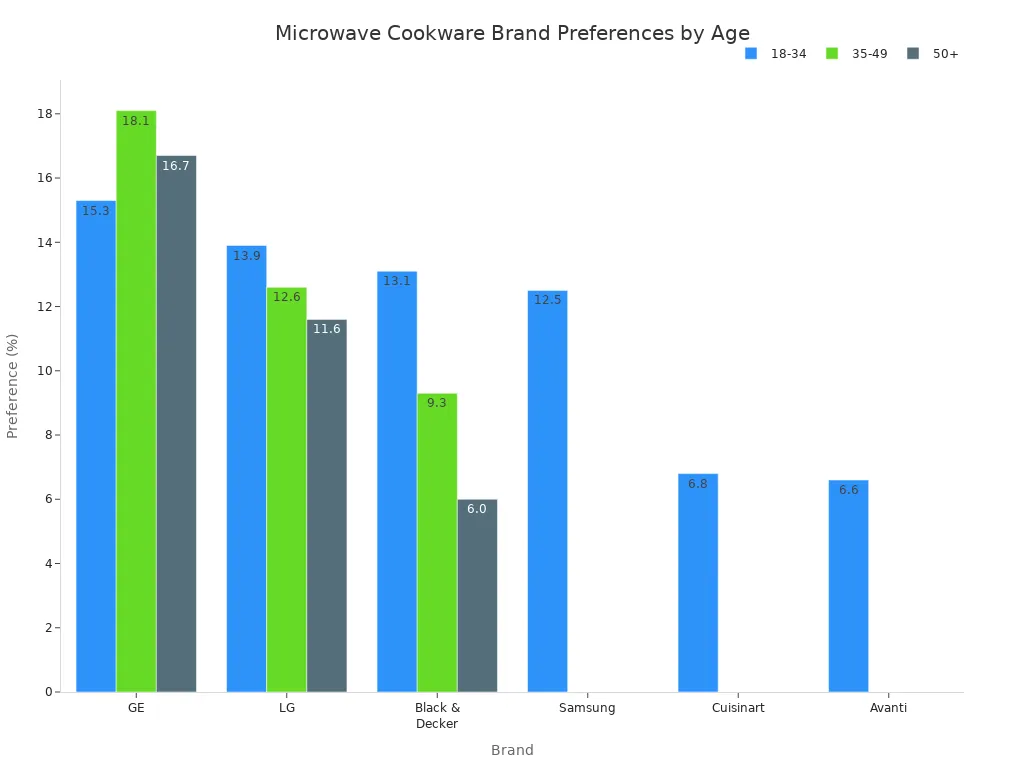
Consumer preferences vary across age groups, influencing brand loyalty and purchasing decisions. The table below highlights preferred brands among different age demographics:
| Age Group | Preferred Brand | Percentage |
|---|---|---|
| 18-34 | GE | 15.3% |
| LG | 13.9% | |
| Black & Decker | 13.1% | |
| Samsung | 12.5% | |
| Cuisinart | 6.8% | |
| Avanti | 6.6% | |
| 35-49 | GE | 18.1% |
| LG | 12.6% | |
| Black & Decker | 9.3% | |
| 50+ | GE | 16.7% |
| LG | 11.6% | |
| Black & Decker | 6% |
As the market evolves, the Microwave-Safe Utensils Market is projected to grow at a CAGR of 5.7%, increasing from an estimated USD 9,644.3 million in 2025 to USD 16,788.8 million by 2035. This growth indicates a strong consumer shift towards microwave-safe options, including products like the microwave grill pan, which offers healthier cooking alternatives.
Customization Benefits for Brand Differentiation
Customization plays a crucial role in helping kitchenware brands stand out in a competitive market. By tailoring products to meet individual consumer preferences, brands can enhance loyalty and create a unique identity. The demand for multifunctional and aesthetically pleasing microwave cookware aligns with modern consumer lifestyles and sustainability trends.
Brands can leverage customization in several ways:
- Unique Designs: Customization allows brands to create distinctive tableware designs that enhance their image and appeal to lifestyle-conscious consumers.
- Exclusive Products: Companies like LovingHome offer full-process customization, enabling brands to develop exclusive products efficiently. This approach helps brands differentiate themselves from competitors.
- Small Batch Options: Startups benefit from small batch customization, which reduces risks associated with new product testing. This flexibility encourages innovation and responsiveness to market trends.
The integration of smart features in microwave cookware also sets brands apart. For instance, incorporating temperature sensors and app connectivity redefines convenience and safety. This innovation appeals to tech-savvy consumers, giving brands a competitive edge.
Moreover, customization allows brands to achieve unique shapes, textures, and molds. This level of personalization enhances brand recognition and product differentiation. Custom kitchen utensils can reflect a brand’s personality and values, establishing a strong connection with customers. Such differentiation reinforces brand loyalty and creates memorable products.
As consumers increasingly seek kitchenware that combines functionality with style, brands must adapt. The rise of products like the microwave grill pan exemplifies this trend, offering healthier cooking alternatives while maintaining aesthetic appeal. By embracing customization, kitchenware brands can effectively navigate the evolving market landscape.
Cost Efficiency Through OEM Partnerships
OEM partnerships offer kitchenware brands significant cost efficiency, which can enhance their pricing strategies and overall profitability. By collaborating with experienced manufacturers, brands can streamline production processes and reduce expenses.
One of the primary advantages of OEM partnerships is the ability to customize products without incurring excessive costs. Customization allows brands to differentiate their offerings, which can justify premium pricing. However, it is essential to consider how customization impacts pricing strategies. The following table outlines key aspects of OEM partnerships and their effects on pricing:
| Aspect | Impact on Pricing Strategy |
|---|---|
| Customization | Allows differentiation, affecting pricing based on costs. |
| Minimum Order Quantities (MOQs) | Higher customization may lead to higher MOQs, impacting pricing. |
| Lead Times | Customization can extend lead times, influencing pricing strategies. |
| Cost Structures | Custom materials and molds increase overall costs, affecting pricing. |
Additionally, brands can benefit from economies of scale. By producing larger quantities of microwave cookware, they can lower per-unit costs. This reduction in costs can be passed on to consumers, making products more competitive in the market.
However, brands must also navigate challenges when working with OEM manufacturers. High complexity and certification requirements can increase development costs by approximately 19% for nearly 28% of OEM/ODM suppliers. Compliance checks may delay about 22% of prototyping cycles, impacting time-to-market. Furthermore, supply chain volatility can affect margins, with 24% of manufacturers citing volatile component costs. Material shortages can also cause delays in production timelines by up to 14% for nearly 18% of manufacturers.
Despite these challenges, the potential for cost savings through OEM partnerships remains substantial. Brands that effectively manage these relationships can achieve a competitive edge while offering innovative products like the microwave grill pan.
Ensuring Quality Assurance in OEM Products
Quality assurance is vital for kitchenware brands that partner with OEM manufacturers. Ensuring that microwave cookware meets safety and performance standards builds consumer trust and enhances brand reputation. OEM manufacturers implement several quality control processes to guarantee product integrity.
The following table outlines typical quality control processes used by OEM manufacturers for microwave cookware:
| Quality Control Process | Description |
|---|---|
| Certifications | Manufacturers obtain certifications like FDA, LFGB, CE, and RoHS to ensure safety and compliance. |
| Rigorous Testing | Products undergo tests for thermal shock resistance, handle strength, impact resistance, and more. |
| Transparency | Displaying certifications builds trust with consumers and ensures product integrity. |
To ensure safety and quality, microwave cookware must comply with national regulations and exceed industry norms established by recognized bodies such as ASTM and EN. This compliance is crucial for food contact products to avoid transferring hazardous chemicals into food.
The following table lists essential tests required for microwave cookware:
| Test Type | Description |
|---|---|
| Microwave-safe test | Evaluates cookware’s resistance to microwave heating, applicable to ceramic, glass, and plastic. |
| Dishwasher-safe test | Assesses the durability of cookware in a dishwasher. |
| Oven-safe test | Tests cookware’s performance in an oven environment. |
| Freezer-safe test | Determines how cookware performs in freezing conditions. |
| Standard | EN 15284 |
Additionally, manufacturers must consider various factors during testing, including chemical safety under worst-case conditions, organoleptic properties, and overall migration. These assessments ensure that the cookware performs well and remains safe for consumer use.
By prioritizing quality assurance, kitchenware brands can confidently market their products, knowing they meet the highest standards. This commitment to quality not only enhances customer satisfaction but also fosters brand loyalty.
Expanding Product Lines with Custom Microwave Grill Pans
The introduction of custom microwave grill pans presents a significant opportunity for kitchenware brands to diversify their product offerings. These innovative products cater to a wide range of consumer needs by providing various sizes, shapes, and materials. Brands can align their microwave grill pans with specific market niches and consumer preferences through customization options. This adaptability enhances the appeal of these products, especially among consumers seeking convenience and sustainability.
Kitchenware brands are focusing on several popular features in custom microwave grill pans. Advanced material innovations, such as ceramic and silicone, offer benefits like heat resistance and durability. User-centric designs with ergonomic handles and optimal heat distribution are also emphasized. Furthermore, smart features like Wi-Fi connectivity and scan-to-cook technology are becoming common, enhancing convenience and efficiency in cooking.
However, expanding product lines with custom microwave grill pans does come with challenges. The following table outlines some of the key obstacles brands may face:
| Challenge Type | Description |
|---|---|
| Market Saturation | Numerous brands and product options make it difficult for new entrants and existing players to maintain market share. |
| Rapidly Changing Consumer Trends | Companies must adapt quickly to evolving consumer preferences to avoid obsolescence and declining sales. |
| Regulatory Compliance and Supply Chain | Compliance with stringent regulations and managing supply chain complexities can increase costs and complicate product development. |
By addressing these challenges, kitchenware brands can successfully expand their product lines with custom microwave grill pans. This strategic move not only enhances their market presence but also meets the growing demand for multifunctional cooking tools.
OEM custom microwave cookware presents significant advantages for kitchenware brands. These partnerships enhance product differentiation, cost savings, and brand reputation. Brands can leverage the following benefits:
- Manufacturers prioritize safety by using compliant materials, which builds consumer trust.
- Customization options allow brands to create unique products that resonate with their target audience.
To maximize these opportunities, brands should consider strategic recommendations, such as evaluating OEM capabilities and ensuring quality control systems. By embracing these strategies, kitchenware brands can position themselves for growth in a competitive market.
FAQ
What is OEM custom microwave cookware?
OEM custom microwave cookware refers to products designed and manufactured by Original Equipment Manufacturers for brands. This collaboration allows brands to enhance their kitchenware offerings while focusing on branding and marketing.
How can customization benefit my kitchenware brand?
Customization helps brands differentiate their products, catering to specific consumer preferences. Unique designs and features can enhance brand loyalty and create a distinct market identity.
What are the safety standards for microwave cookware?
OEM manufacturers ensure safety by adhering to international standards like FDA and LFGB. They conduct rigorous testing to guarantee that products are safe for food contact and microwave use.
How does partnering with an OEM improve cost efficiency?
OEM partnerships streamline production processes, reducing overall costs. Brands can benefit from economies of scale, allowing them to offer competitive pricing while maintaining quality.
What challenges might brands face when expanding product lines?
Brands may encounter market saturation, rapidly changing consumer trends, and regulatory compliance issues. Addressing these challenges is crucial for successful product line expansion.